
Philippe de Villiers
Vatnik Soup, X Articles,
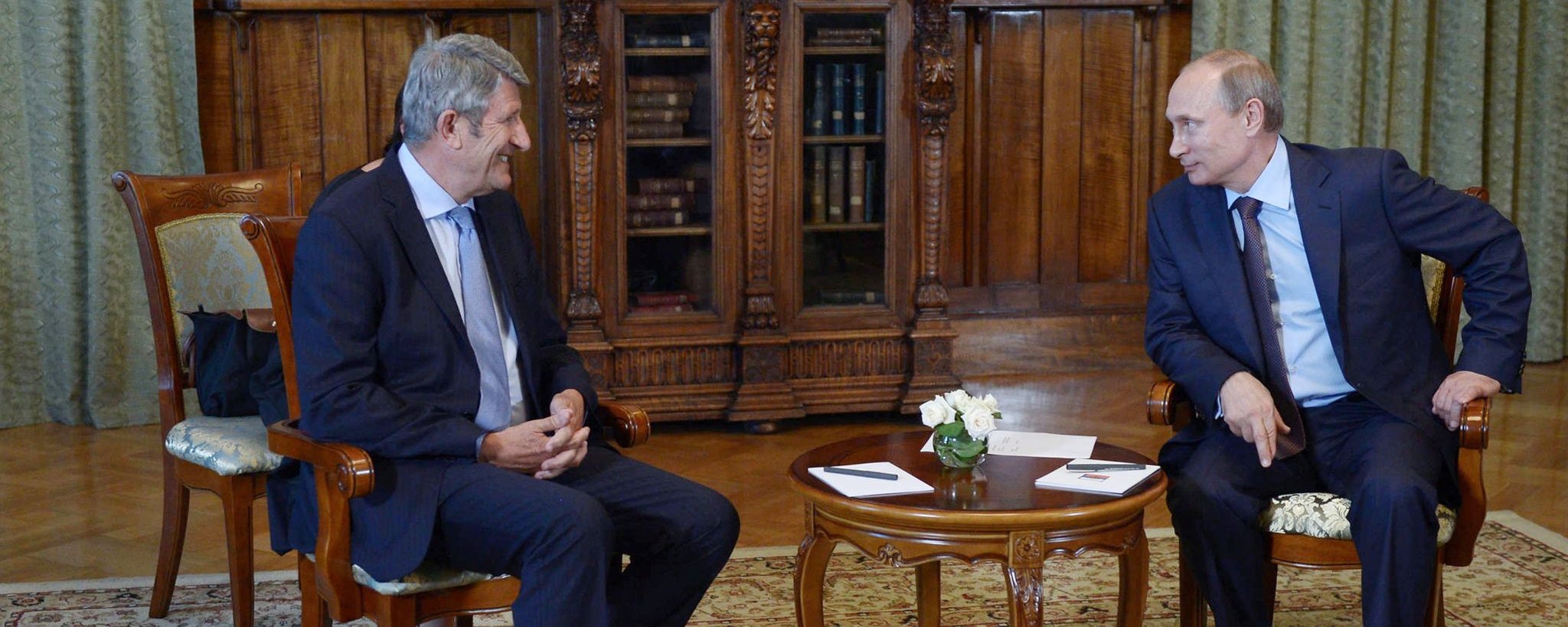
In today’s Vatnik Soup, we’ll introduce Philippe de Villiers, a French politician and entrepreneur. He’s best known for his highly political Puy du Fou theme parks and for pretending to champion French sovereignty while actually bowing to Russian imperialism.
De Villiers is no fringe newcomer. A former minister, MP and MEP, he founded the Mouvement pour la France (MPF) and created the hugely successful Puy du Fou historical theme park in Vendée. He was a presidential candidate twice, before backing Éric Zemmour for 2022, another vatnik.
His defining political battle has been “sovereignty”. In 1992, alongside Philippe Séguin and Charles Pasqua, de Villiers became one of the leading voices of the “No” campaign against the Maastricht Treaty and deeper European integration.
Over time, this “souverainisme” became part of a wider civilizational worldview: that Brussels, NATO and US influence threaten French independence, while national identity, Christianity and “traditional values” have to be defended from a decadent, globalist West. You know where this is going.
Servile admiration for war criminal Putin
In 2014, de Villiers described a “formidable historical inversion”: the “free world” was now supposedly defended by Putin against the Americans and the “Globalist International.”
The following year, he praised Putin’s Russia for restoring “moral, civic, patriotic and spiritual values” — and even claimed there was “more freedom of expression” in Russia than in France.
Yes, in Russia.
De Villiers likes to invoke Solzhenitsyn, the brilliant writer and famous dissident persecuted by the Soviet Union, but also an anti-Ukraine Russian nationalist. Putin’s Russia, however, produced a new generation of persecuted dissidents, who somehow interest him far less: Politkovskaya was murdered on Putin’s birthday, Khodorkovsky spent a decade in Putin’s gulag, Kasparov is in exile and Navalny was poisoned, jailed and died in a penal colony.
Today Russia ranks 172nd of 180 in RSF’s press-freedom index, with 48 journalists imprisoned as of April 2026. For many “right-wing” vatniks, past Soviet repression is something safe to criticize that fits into their “left-wing bad” discourse, but when a lifelong KGB agent does the same or worse today but with a thin “traditional values” veneer, they all fall on their knees.
And Philippe’s admiration for the dictator soon became very concrete. In August 2014, a few months after Russia occupied Crimea, de Villiers met Putin in Yalta to discuss two Puy du Fou-style parks, including one on Russian-occupied Ukrainian territory.
He brought his son Nicolas with him. Nicolas, who runs the park business, said of Putin: “He is different from how we expected. He has sweet words and sweet eyes.”
Good grief.
Nicolas also gave us an extraordinary Crimea quote in 2015: “Historically speaking, Crimea was Russian for centuries… Now Crimea is Russian again and we hope our scheme can provide a peaceful means to help people find their identity.”
Crimea is part of Ukraine, as even Putin unequivocally acknowledged in 2004—ten years before invading it.
Real and imaginary gulags
De Villiers claims Solzhenitsyn taught him to detect “the gulags of our time”, but it looks like he failed completely: anything about Putin’s “penal colonies”? His network of filtration camps in Ukraine? POW camps in occupied Ukraine where even civilians are held indefinitely, starved and tortured to death? Silence.
Conversely, on 16 October 2026, Philippe called the removal of bus advertisements for his book “the gulag”. He was, of course, neither arrested nor sent to a camp. Yet he invokes Solzhenitsyn, who spent eight years in Stalin’s prisons and concentration camps, in appalling conditions. Sigh.
Solzhenitsyn later turned his own experience of the Gulag and testimony from other former prisoners into The Gulag Archipelago. But de Villiers even gets that wrong: he claims the book was the reason Solzhenitsyn was sent to the Gulag. That is obviously false: Solzhenitsyn was arrested in February 1945 for private letters criticizing Stalin and left the camps in 1953. The book was first published in Paris in December 1973, twenty years after he left the camps. Publication led to a new arrest, loss of citizenship and expulsion to West Germany in February 1974—not to his Gulag sentence. So much for his history lessons.
He goes on to accuse “the left” of burning books. Not a word, of course, about the history books actually burned in occupied Crimea—the occupation he planned to celebrate with his new Puy du Fou project. East SOS recorded testimony from a former pupil in Armiansk: after Russia’s occupation began in 2014, Ukrainian books were thrown away or burned in a yard near the school, a pattern repeated across Russian-occupied regions as part of Russia’s genocidal campaign to erase Ukrainian culture.
Fake sovereignty
Now, even the original Puy du Fou isn’t just de Villiers’ successful theme park business. It’s controversial as part of his nationalist politics. He even boasted that “metapolitics” mattered more than politics and that through his books and Puy du Fou he’d spread far more ideas than he could as just another politician.
In a generous interpretation, Puy du Fou was born from de Villiers’ desire to memorialize local people he believes were victims of revolutionary terror and genocide.
Ukraine has its own tragic history of revolutionary and Stalinist mass violence and genocide: the Holodomor, Stalin’s deliberate starvation of Ukrainian resistance, and the deportation of the indigenous Crimean Tatars.
The Bolsheviks themselves admired the French Revolution and its Terror, erecting a statue to Robespierre in 1918 — the very revolutionary tradition de Villiers built his Vendée mythology against.
In a sane world, a Ukrainian Puy du Fou might have taught that history.
Instead, de Villiers wanted one in Russian-occupied Crimea, celebrating the alleged “Russian soul” — while Moscow denies the Holodomor as genocide, invaded sovereign Ukraine, suppresses Ukrainian and Crimean Tatar identity, and deports Ukrainian children with clear intent to erase Ukrainian culture and identity.
Everything an actual “sovereignist” would hate.
A lifelong preacher of national sovereignty was proposing a Russian national-history park on land Russia had just taken from another sovereign nation.
And his Russian partner was no ordinary investor. It was Konstantin Malofeyev, the sanctioned ultranationalist behind Tsargrad and a key patron of the Russian imperialist milieu around Aleksandr Dugin.
Their planned venture even had a name: Puy du Fou Tsargrad.
Maybe because they interfered with his cynical business plans, de Villiers called Western sanctions “acts of war.” And the story didn’t simply end with sanctions. Documents published by the Guardian in 2026 indicate cooperation with Malofeyev continued well into 2015, with executives discussing ruble payments and an offshore structure to avoid sanctions.
Dugin and his Malofeyev-oligarch network want a Russian empire from Vladivostok to Lisbon, with supposed “sovereignists” like de Villiers as useful idiots for Russian imperialism. Dugin’s daughter Daria even interviewed de Villiers, quoting him: “the future of Europe must be written together with Russia!”
On 24 February 2022, Putin launched his full-scale invasion of Ukraine — an imperial war aimed at subjugating a neighboring country, with unambiguous, recognized borders.
For a lifelong defender of national sovereignty, that would have been a good time to finally wake up.
Instead, de Villiers doubled down on Kremlin-spread, stale vatnik narratives: NATO responsibility, Western “escalation,” European defenders as the “warmongers,” and Ukraine as historically inseparable from the invading Russia.
Some “souverainism”.
A servant of the Kremlin
By 2025, after Russia had been bombing a European capital for years, murdering countless civilians, Philippe was still calling the Russian threat “a lie.”
While France itself attributes GRU cyberattacks on French institutions — and attempts to destabilize its 2017 election — to Russia, the French souverainist / Kremlin servant proclaimed that “Russia is not our enemy.”
De Villiers also gained a much bigger megaphone: he became a star of Collabolloré’s Bollosphere ecosystem, just as it grew increasingly comfortable with pro-Kremlin narratives around RT’s former director, Xenia Fedorova (France is finally exercising its sovereignty and has ordered her expulsion).
De Villiers says he and Bolloré often dine together: “I introduce him to people.” He even offered to join Bolloré in jail if it came to that, playing the martyr. Needless to say, he’s still not in prison.
In June 2026, Bolloré’s JDNews put de Villiers on a cover urging France to “renew ties with Russia” and stop the “escalation toward war.”


Even RN leader Jordan Bardella publicly distanced himself from that: “These positions are not mine.”
When your Russia take is too pro-Russian even for the party that took a €9 million Russian bank loan and spent years defending Putin, you know you’ve achieved something in the vatnik world.
For de Villiers, history is supposed to protect a nation against outsiders who would dissolve its identity. But in Crimea, he was willing to help Russia use history for exactly the opposite purpose: to absorb another nation’s territory into its own imperial story.
That makes de Villiers just yet another hypocrite and useful idiot of Russian imperialism, not a defender of Ukrainian or French sovereignty by any stretch of the imagination. Not even by his theme park standards.
Russia spends $5 billion a year on propaganda to manufacture passivity towards its genocidal invasions. We don’t have a theme park, but we make “soups” like these to counter it and actually defend the sovereignty of European nations. Please support our work.