
Switzerland’s “Neutrality” Vote Is Really About Sanctions
Vatnik Soup, X Articles,

On 27 September, Swiss citizens will vote on the ballot initiative “Safeguard Swiss neutrality”. Superficially, its promise can sound appealing: peace, sovereignty, and permanent armed neutrality. But most of that is a distraction: Switzerland is already neutral, and it is not about to be dragged into NATO; membership would already require a mandatory nationwide referendum and a majority of both voters and cantons. The main question is narrower: the initiative would sharply restrict Switzerland’s ability to impose sanctions on belligerent states.
From Russia’s invasion to the initiative
The chronology is revealing. Russia launched its full-scale invasion of Ukraine on 24 February 2022. Four days later, on 28 February, the Swiss Federal Council decided to adopt the EU sanctions against Russia.
Then, on 15 October 2022, the newly founded Pro Schweiz backed the Neutrality Initiative and Christoph Blocher presented its text in Bern.

Christoph Blocher is one of the most influential figures in modern Swiss politics. The billionaire industrialist and former Federal Councillor led the successful campaign against joining the European Economic Area in 1992 and played a central role in transforming the SVP (Swiss People’s Party) from a relatively modest conservative party into Switzerland’s dominant political force. For decades, he also led the Campaign for an Independent and Neutral Switzerland, or AUNS, which was merged with two other Eurosceptic groups in 2022 to create Pro Schweiz.
Blocher had advocated a stricter conception of Swiss neutrality long before 2022, but Russia’s invasion and Switzerland’s sanctions response gave that project its immediate purpose.
The Blochers — and the people around them
Blocher’s daughter, Magdalena Martullo-Blocher, is an SVP politician, a member of the initiative’s main campaign committee, and the CEO and a major shareholder of EMS-Chemie, the company she took over from her father.

EMS-Chemie has operations in Russia and strong commercial interests in China. After Russia invaded Ukraine, the company instructed employees to refer to the invasion as the “Ukraine conflict” rather than “war,” officially to protect them after Russia made it illegal to call its war a war.

The wider political-media environment is equally telling. Roger Köppel, owner and editor-in-chief of Weltwoche and a long-time Blocher ally, has conducted friendly interviews with some of the Kremlin’s most infamous propagandists, including Vladimir Solovyov and RT editor-in-chief Margarita Simonyan.
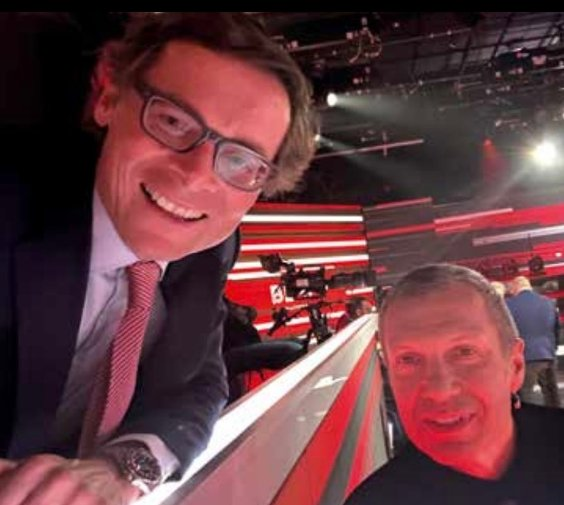
In July, Köppel interviewed Simonyan in Moscow for Weltwoche under the headline “Europeans, stop this war!” and gave her ample space to portray Europe as the aggressor and Russia as the poor little victim with no bad intentions towards Europeans whatsoever. Somehow Ukrainians don’t count: the daily terror bombing of a sovereign European country; the atrocities of Russian occupation; the kidnapping and Russification of European children. Not to mention Russia’s hybrid war against the rest of Europe or Simonyan’s own belligerent statements against all of us. Of course, Köppel did not ask about any of this.

Switzerland punches far above its weight
Swiss sanctions are far from symbolic. Switzerland may be a small country, but as a financial and commodity-trading centre it punches far above its weight. Before the full-scale invasion, roughly 75% of Russian coal trading and around 60% of Russian oil trading was handled through Switzerland. By July 2026, Switzerland had frozen around CHF 8.5 billion in assets connected to sanctioned Russian individuals and entities.

Swiss precision industry matters too. Russia’s arms industry depends heavily on advanced machine tools, spare parts and industrial equipment. Swiss-made machinery has been found inside Russian weapons production, and Swiss authorities themselves warn manufacturers about sanctions circumvention through third countries. Sanctions force Russia to build shell companies, reroute shipments through third countries, pay higher prices and accept slower, less reliable supply chains.
Sanctions do not have to be watertight to matter, but unity does: every major financial centre, industrial economy or trading hub that does not participate weakens the collective economic pressure on the target state. The initiative does contain an exception allowing measures intended to prevent other countries’ sanctions from being circumvented through Switzerland. What that exception would mean in practice is far from obvious, and removing Switzerland itself from coordinated sanctions would create a significant gap in a system whose effectiveness depends heavily on major financial and industrial centres acting together.
The Security Council trap
Outside that anti-circumvention exception, the only sanctions Switzerland could still impose directly on a belligerent state would be those approved by the UN Security Council, which makes the UN exception largely useless in the cases that matter most: Russia can just veto UN sanctions against itself, and if China attacks Taiwan, Beijing could do the same.

Switzerland would then be constitutionally prevented from joining sanctions imposed by its democratic partners. For an initiative marketed as a defence of Swiss sovereignty, that is an extraordinary outcome: Switzerland would surrender much of its sovereignty over sanctions decisions concerning belligerent states to the veto of any permanent member of the UN Security Council.
“No war”
The initiative’s supporters campaign under the peacenik slogan “No war!”.
But war cannot simply be abolished by decree or legislation — not even by one drafted with all the legendary precision of Swiss constitutional engineering. Magdalena Martullo-Blocher could instruct her employees not to call Russia’s brutal war a war; Switzerland alone cannot force Russia to stop actually waging it. But coordinated sanctions can: precisely what the initiative is trying to prevent.

And sanctions are not war. Switzerland has in fact gone to great lengths to remain militarily neutral during Russia’s ongoing invasion of a peaceful nation, including blocking Germany, Denmark and Spain from transferring Swiss-origin weapons and ammunition they already possessed to Ukraine. Swiss authorities themselves acknowledge that some of these restrictions already go far beyond what international law actually requires of a neutral state.
Sanctions are precisely one of the main alternatives to military involvement: a way to raise the economic cost of aggression, constrain war economies and deter future attacks, without sending a single Swiss soldier anywhere.

The “No war!” slogan is particularly dishonest. The initiative does not prohibit Switzerland from sanctioning peaceful states; it specifically prohibits sanctions against belligerent ones. Absurdly, Switzerland could therefore impose sanctions on a state while it is at peace, yet — outside the UN and anti-circumvention exceptions — would have to lift them if that state went to war. It is difficult to imagine a more literal way of rewarding aggression: under a proposal advertised as “No war!”, becoming a belligerent state would actually protect you from Swiss sanctions.
Russia’s invasion justified the sanctions, not the other way around. A policy that prevents Switzerland from sanctioning aggressors can make wars cheaper to start, easier to sustain and less costly for the states that launch them. Under a proposal advertised as “No war!”, going to war is precisely what would protect a state from Swiss sanctions. Refusing to impose costs on a state that starts a war of aggression — or worse, rewarding it — does not make war disappear; in fact, it can help that war continue and increase the risk of future wars too. Even for Switzerland.
Read our full report: Switzerland’s Neutrality Initiative: Neutrality, Sovereignty and the September 2026 Vote